

The composer
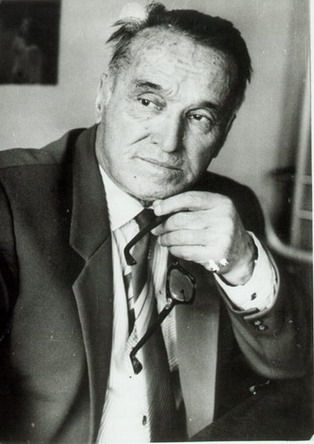
Ziyodullo Shahidi
Зиёдулло Шаҳидӣزیادالله شهیدیЗиядулло Мукадасович ШахидиZiyodullo Shohidiy
The record
- Born
- Died
- Buried
- Sari Osiyo cemetery, Dushanbe
- People's Artist of the Tajik SSR
- Rudaki State Prize
- UNESCO
- UNESCO placed his centenary on its list of memorable dates for 2014-2015
- Chair, Union of Composers
1956-1960— sources disagree; show all 2 claims
1956-1960Шахиди, Зиядулло Мукадасович extracted
Chairman of the board of the Union of Composers of the Tajik SSR.
1956-1961Зиядулло Шахиди extracted
Some sources close the term a year later.
Born in Samarkand — in Munira Shahidi's words the city of his birth and of the founding of his family. What the household is documented to have been is a musical one: his father kept a shashmaqom salon in the Jadid-influenced intellectual milieu of the city.
We wrote our own account of him in English around 2004, for the Foundation’s first website. Most of the English writing about him since comes out of it, the encyclopedia entries included. It opens like this:
After The Second World War, in 1946, a group of Tajik melodists entered Moscow Conservatory, but only one of them managed to graduate from that School of Music. He was Ziyodullo Shahidi (1914-1985). Merging maqam with symphony, he formalised modern Tajik music and became known as an outstanding figure of this form of synthesis. The reconciliation of different cultures as an idea goes back to the philosophy of Abu Ali Ibn Sina (born in Bukhara in 980), known in Europe as Avicenna.
Samarkand
He was born on 4 May 1914. Samarkand was in the Russian empire then and is in Uzbekistan now, and for centuries before either it was a Persian-speaking city of poets. His father, Muqaddaskhon Shahidi, was a musician. The shashmaqom was played in the house, and Firdausi, Rudaki, Hafiz and Jami were read aloud in it.
He overcame two crucial events in the culture of the region: the replacement of Arabic-based Farsi and Turkish by Cyrillic, and the persecution of intellectuals — his father, Muqaddaskhon Shahidi, was murdered during the Bolshevistic terror of 1937.
He was killed in 1937. One account has him arrested by the NKVD and dead in prison six months later; another has him shot.
Theatres, and the Conservatory
He left primary school in 1932 and taught. Until 1939 he worked as a musician in the theatres and radio studios of Tashkent, Samarkand and Stalinabad, the city that became Dushanbe, and he had a hand in setting up the modern theatres of Tashkent and Samarkand. From 1939 to 1952 he directed the song-and-dance ensemble of the Tajik State Philharmonic. He joined the Union of Composers of the Tajik SSR in 1940. Before 1941 he was known chiefly as a player of the gidjak.
He did not study composition until he was nearly thirty. From 1943 he worked at the studio of the Union of Composers with Alexander Lensky and Sergei Balasanyan. He entered the Moscow Conservatory in 1946, completed the national studio there in 1949, and joined Vladimir Fere’s composition class from 1952 to 1957. He was forty-three when he graduated. The early instrumental pieces are a Rondo of 1948 and a “Concert for piano & violin” of 1949, which our own text calls “inspired by the search for new forms, styles, and expressions of modern music”.
The songs
However, vocal art was his favoured form. Transforming the ideas of the classical poets Rudaki, Saadi Sherazi, and Hofiz into the modern musical sphere, and co-operating with contemporary poets such as Lohuti, Tursun-Zoda, Rahimi, Dehoti, he aimed to transform the liberty of their thoughts into a new musical style belonging to his own time. This feature of his art was an integral part of the radio music of that period, linking Tajiks, Uzbeks, Iranians, and Afghans of the 50s and 60s, and bringing them out from their political isolation.
More than three hundred songs and fourteen romances. Vatan, Sitorai man, Khonai mo, Zi suzi sina, Ey sorbon on words of Saadi. Shoista Mullojonova sang them, and Hanifa Mavlonova, and Muqaddas Nabieva. They went into the gold fund of Tajik radio.
The 1957 argument
He did not begin as the classical tradition’s defender. Early on he would not grant Tajik traditional music, shashmaqom included, the standing of a professional art, and he said so where other people could answer him. On 6 May 1957 Tojikistoni Soveti printed a summing-up of the discussion on the development of Tajik music, subtitled “a reply to Z. Shahidi”.
Then he changed his mind. From the second half of the 1960s he worked mainly in symphonic forms. Buzruk came in 1972 and the Symphony of Maqams in 1977, and both of them are built on the tradition he had argued against.
Ziyodullo Shahidi’s constant dream to transform maqams into symphony was realized during the early 50s, gradually changing his style of thinking and developing his musical identity. Driven by his enlightening character to draw the attention of his countrymen to symphonic thought, his composition was based on the interpretation of the original classical cycle Shashmaqom within the modern European harmony.
Public life
He was chairman of the Union of Composers of the Tajik SSR from 1956 to 1960, the first Tajik to hold the post, and he spent it arguing for European notation and polyphony against a good deal of resistance. He directed the Dushanbe music college in 1964 and 1965. He sat in the Supreme Soviet of the Tajik SSR through four convocations and had been a party member since 1950. He wrote in the press and talked about music on radio and television constantly. A Russian source of 1990 gives his reason: he held that a composer’s duty was not only to write music but to argue in public for the best of it, and to take an active part in the education of ordinary listeners.
Order of the Red Banner of Labour in 1957. People’s Artist of the Tajik SSR in 1964. The Rudaki State Prize, Tajikistan’s highest award in the arts, in 1984.
He died in Dushanbe on 25 February 1985 and is buried at Sari Osiyo.
Mucaddaskhan Shahidi
Муқаддасхон ШаҳидӣМукаддасхон Шахиди
- Died
- Manner of death
murdered during the Bolshevik terror of 1937— sources disagree; show all 3 claims
That he was killed in 1937 is not in doubt. How is: murdered, dead in custody, or shot. Three accounts, none of them from a record of the case.
murdered during the Bolshevik terror of 1937Ziyodullo Shahidi: Rethinking Maqams And Symphony (part 1) read
The Foundation's own wording.
arrested by the NKVD and dead six months later in Stalin's prisonsШахиди Зиедулло — справка extracted
A more specific account, from a source with demonstrable errors elsewhere in the same entry.
repressed and shotМ. Шахиди: «Отец посвятил себя тому, чтобы посредством своей музыки вытащить людей из традиционной скорлупы» extracted
The interviewer's wording, put to his granddaughter Munira Shahidi, who did not contradict it.
- The salon
- Kept a salon in Samarkand where classical shashmaqom was performed
No birth year was recovered.