

In memoriam
Munira Shahidi
Мунира ШаҳидӣМунира Зиядуллаевна Шахиди
Eldest daughter of Ziyodullo Shahidi. Literary scholar; with her mother Marhabo she made his house into a museum, and in 1992 she founded this Foundation.
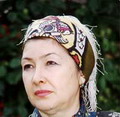
Munira was the eldest of Ziyodullo Shahidi’s children. She was born in Dushanbe on 22 March 1943, when the city was still called Stalinobod. The poet Abulqasim Lohuti was a close friend of her father, and he gave her her name.
She grew up in the house where the music was being written. Ayni came to it, and Tursunzoda, and Bobokulov, and most of the musicians in the republic.
She read English at university in Dushanbe, finished in 1964, and went to Moscow, to the Institute of Oriental Studies. Her subject was British orientalism — E. G. Browne’s four-volume A Literary History of Persia. She wanted to know how the English had come to write about Persian literature the way they did, and where they had it wrong. She stayed with that question for the rest of her life.
Her father died in February 1985. Turning the house into a museum was her mother’s idea and hers; he had left no instruction to do it. Marhabo Shahidi and her eldest daughter decided the rooms should stay open, and in 1987 they opened them. It was the first museum of musical culture in Tajikistan.
She founded the Shahidi Foundation in February 1992, a few months into the civil war. In 1997 it was one of the organisations that signed the General Agreement on Peace and National Accord.
She was writing throughout. Ibn Sina and Dante came out in Dushanbe in 1986, setting the Persian and European humanist poets side by side; the academician Numon Negmatov called it a classic study of Tajik-Persian culture. After it came a two-volume edition of Rumi’s ghazals, translations from English into Russian, and some seventy articles published in Dushanbe, Tashkent, Moscow, Pakistan, Sweden, Japan and France. From 2001 to 2017 she was Editor-in-Chief of the international journal Fonus.
In 1996 she held a fellowship at Gothenburg and went to a conference of music museums and archives in London. Preparing her paper, she looked in the British Library for a survey of Central Asian music over the previous hundred years. There wasn’t one.
That sense of a “void” in the modern system of knowledge became the starting point of my address at the Victoria and Albert Museum. Ziyodullo Shahidi’s songs, in English translation, helped the audience feel the common ground of the ideas of kindness and love of one’s fellow man.
That is what she worked on afterwards. She lectured in Gothenburg and Stockholm, at the Sorbonne and the Académie des Sciences, at McGill and at Cambridge. She was a fellow of the Swedish Institute and of the Maison des Sciences de l’Homme, an associate member of Cambridge, a professor at the Tajik National University from 2017, and a member of the Public Council under the President from 1996. From 2017 to 2022 she led the Tajik side of GCRF-COMPASS, a £2.93m research programme run with the University of Kent. In January 2019 she spoke at the European Parliament.
Her last book happened because two Iranian publishers visited the museum. They stayed a while, and before they left they asked her to let them publish a book of hers — whichever one she wanted. Cultural Ties Between East and West in the 21st Century came out in Oslo at the end of 2024, in Tajik and English, and was presented in Baku, Cambridge, Berlin, Prague, London and Samarkand.
On 2 July 2026 she gave an interview in Samarkand, at Sadriddin Ayni’s house-museum, after a presentation of books about the family. Samarkand was her father’s city and she had come to call it hers. She talked about what he had been trying to do:
From the beginning of the 1950s Shahidi looked for ways of realising the maqam tradition in polyphonic symphonic music. That idea stayed the guiding star of his work. In the union of the maqam and symphonic traditions he saw not a rivalry of cultures but their harmony.
And about why it mattered to keep at it:
The music of the New Silk Road will serve the cause of peace. And where there is peace, the conditions arise for cultural and economic wellbeing.
The last question was what she would wish the readers. She congratulated Uzbekistan on thirty-five years of independence, and finished:
May Uzbekistan and my native Samarkand flourish!
She died in Moscow on 15 July 2026, at her daughter’s home. She was eighty-three. The next day she came home to Dushanbe, and we said goodbye to her in her father’s house — the museum she and her mother made, and the one she kept open for thirty-nine years.